Letter from Jeddah
From January 31, 2026

Dear readers,
I write this newsletter once every month or so. It features my reflections on the deployment of creativity to making the world’s economic systems (and by extension social and to some extent political systems) more inclusive and, therefore, fairer. That sounds like a tall order – and it is!
If you would like to get the updates directly in your inbox, do subscribe!
Walking the old Red Sea port city of Jeddah, early as the new year dawned, I was conscious of its long history. With some Harvard colleagues and 41 MBA students in tow, I was on an immersion trip to the Kingdom of Saudi Arabia – traversing Riyadh, Jeddah, Madinah, and Dhahran in rapid succession. Riyadh is the spanking new metropolis with its financial district and cuisine blending old and new, Madinah is the second city of Islam, and Dhahran the heart of the petrochemical complex that funds the entire Kingdom today.
As a history buff though, it’s Jeddah that most evokes various epochs, not just as a port city that even today is the center of the Kingdom’s commerce, but also since at least the 7th century the gateway to the pilgrimage cities of Islam. With its historically mercantile culture, and openness to myriad influences, it’s quite different from Riyadh’s tribal and traditional origin in the middle of the Saudi peninsula. I began scribbling this blog in Jeddah partly because I retained fond memories of a fleeting two day visit some decades ago, especially of the seaside vistas.
The old city – Al Balad or ‘the town’ in Arabic – is pink. The color comes from the coral limestone used as a building material that originated in the coral reefs along the coast, combined with wood, coming from as far as India, and with beautifully carved, latticed windows called ‘roshan,’ which means light or luminescence in so many languages of which I’m aware – from Arabic to Persian to Urdu to Hindi – referencing the controlled entry of light into private residences, and therefore also of carefully guarded privacy.
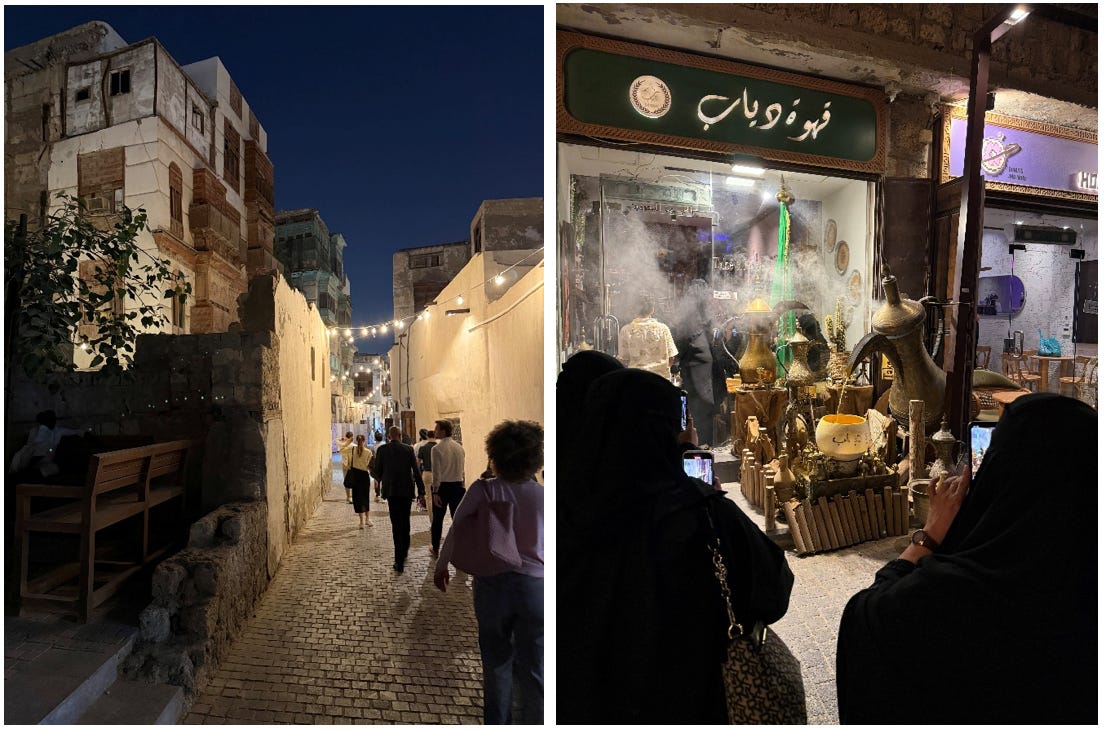
I spent an hour or two wandering through the narrow streets of Al Balad – no different than the narrow alleyways of my maternal and paternal grandparents’ homes in the even older city of Delhi – down to the stray cats that people treat quite kindly. Families jostled against one another – men in thobes and women in abayas of varying degrees of conservative covering – amidst coffee bars, provision stores, small open squares under neem trees, and the occasional unique sobia bar serving a sweet beverage fermented from barley or rice, delicately laced with cardamom and cinnamon.
The intent of the trip was to observe first-hand, albeit briefly, a society in rapid transition. Under Crown Prince Mohammed bin Salman’s Vision 2030 program, initiated in 2016, the Kingdom has sought to transform into a less religiously conservative society, and one that embraces the full spectrum of economic activity rather than relying purely on its vaunted petrochemical complex. It recognizes that the ongoing global energy transition implies a finite horizon for oil and gas, even if their sunset is still likely decades away, and has chosen – aggressively and with premeditated intent – to lean into the future. Hand-in-glove with this societal diversification is an attitudinal shift in the largely very young Saudi population, getting them to embrace change.
As an academic, I had reasoned that there’s much to be learned from a society chomping at the bits to change, trying to accelerate a couple of generations of change into not much more than a decade. How might that work, it at all? How can one balance tradition with an emergent form of modernity?
In the Fall of 2025, the involved graduate students and faculty met in academic settings, reading tomes, reports, popular press, and interviewing and engaging virtually and in person with experts on the Kingdom and the Middle East. But, as is my wont, I read widely in preparation for our short but intense immersion. A popular recent book chronicling the rise of the Crown Prince was the journalist Karen Elliott House’s The Man Who Would be King, a breezy introduction to the reform process on which our class was focused.
But the book that had much more of an impact on me was Arabian Sands, first written in 1959 by William Thesiger, a product of colonial Britain, educated at Eton and Oxford, but really at home in Africa and the Arab nations. Thesiger, born in Abyssinia (now Ethiopia), discusses how he traverses Rub’ al Khali, the Empty Quarter, the least inhabited part of the region – now spanning Saudi Arabia, UAE and Yemen – on foot and camel, several times. As the British diplomat Rory Stewart notes, he does it not as ‘the last Victorian ... [but] the first hippie on the overland trail’ intent on exploring an area no human had traversed to feel at one with the Bedu (Bedouin). The book had an effect on me because it laid bare the traditional culture atop which today’s modernization is occurring. Somehow, viscerally, it’s a finger on the pulse of the substrate of today’s Saudi kingdom.
Through our immersion, two vignettes stayed with me, one each emblematic of social and economic change. The former had to do with the very visible change, relative to even a decade ago, of the role of women in society; the latter had to do with the rise of entrepreneurship, and the very real limits to its short-run possibilities.
A young lady, Shahad Geoffrey, exemplified both the social and economic possibilities. First, the very fact that I got to know her was not something that would have been easy a decade ago. Second, the fact that she is an entrepreneur who has struck out on her own – that too, to build an online fashion business – would have been preposterous to think of even very recently.
Shahad attended our class virtually last Fall, when we discussed a teaching case that an HBS colleague had written on her entrepreneurial venture, Taffi. The company’s website today presents itself as helping “fashion retailers drive more sales with agentic solutions that personally inspire and support shoppers.” My recollection is that it originated some years ago as Shahad – I discovered that the name means ‘honey’ in Arabic just as it does in Hindi and Urdu) – experienced frustration as a young fashion stylist and online shopper, trying to make sense of impersonal online shopping for clothes. She envisioned a technology-enabled online personalized fashion counselor.
Unusually for young women from that part of the world, she then spent time in Paris, learning the ropes, and found her way to an entrepreneurship boot camp in the Bay area, learning the chops so to speak, before putting together a motley crew of talent spread across Egypt, India, Vietnam, building a ‘global’ startup. By the time we met her virtually, Taffi had come some distance to viability. It was fun to see the rough and tumble of building a new venture, in an environment unaccustomed to these, especially shepherded by a female founder, and to watch the men and women in my class interrogate her good-naturedly. A fabulous learning experience.
In Jeddah, Shahad’s home town, my co-instructor Andy Zelleke and I got to meet her as she displayed fabled Arab hospitality by taking us to a celebrated local fish restaurant that was simply delectable. You got to choose your fresh seafood, which they then cooked, in very short order, to your specifications. Unbeatable, and very different from Riyadh’s Najdi cuisine!
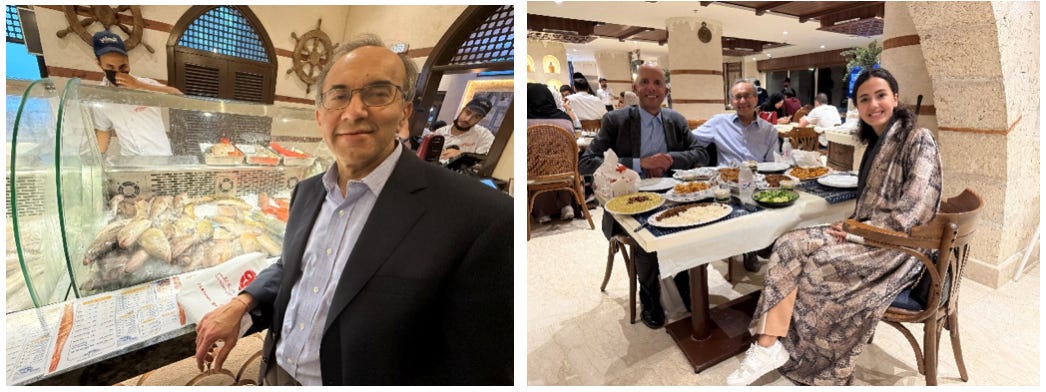
As exemplified perhaps in a fairly extreme fashion by Shahad, women’s emancipation is now extensive. Most visibly, women are free from the earlier stringent requirement of having to be accompanied by male chaperones (from their family) whenever they traveled outside the home; importantly, they can drive, which was also forbidden earlier. While it is still a conservative society, one is no longer stopped if accompanying someone of the opposite sex inquiring whether the relationship has been sanctified by marriage.
Whether you’re positively surprised beyond the initial reaction though depends on your priors about the rate of change. Under the surface, the pace of change is somewhat slower. Informal norms are still constraining. We met with several women in their workplace settings. Their responsibilities were far more extensive than they would have been some years ago, but they reported that the men in the office were still learning how to work professionally with women – gender discrimination that manifested in the form of limited feedback and fewer challenges coming their way - not by intent but by virtue of inexperience. There were not yet enough women in positions of authority, nor enough women role models.
When we visited King Abdulaziz University, where our students mingled with theirs, males and females sat on different sides of the room. One Arab student explained that instruction even in grade school was always delivered by instructors of the same sex.
On the other hand, nor are visible symbols associated with conservatism indicative of fewer freedoms. For example, women wore their abayas – loose robe-like garment worn by women in the Muslim world – even in settings where there was no such expectation. Certainly, the street had moved on from almost universally black abayas to a riot of colors and patterns, such as those facilitated by Shahad and her ilk. Tellingly, an American student with our group, who lost her luggage and bought some abayas, felt super comfortable wearing these daily. As she put it, she’d rather not be scrutinized for her physical appearance and clothes, and preferred to be part of the Arab sisterhood.
Turning to the economic, having been exposed to a number of HBS students keen on being entrepreneurs across the Arab world, and having spoken to the likes of Shahad, our course participants wrestled with how far the entrepreneurial ecosystem had developed in response to the Crown Prince’s Vision 2030. One of our students, originally from Venezuela, another oil-rich country, reminded us that back in 1936, the author Arturu Uslar Pietri urged his people to ‘sembrar el petróleo,’ to sow oil so as to convert oil to more diversified sources of wealth. The sowing was meant to be channeled through the public goods of education, health, and so on, to allow youthful entrepreneurial fervor to birth many possibilities. It has not come to pass almost a century later.
Having personally watched, and participated in, the process of entrepreneurial awakening in both China and India, over the past three decades, I know that it takes time. The intriguing thing about the Saudi experiment is the avowed intention of far greater speed – a race to diversify before the current oil industry became a smaller source of largesse.
On the input side, the Kingdom’s progress has been arresting. The PIF (Public Investment Fund) – capitalized by money ultimately from Saudi Aramco, the petrochemical giant – has been the financial institution that channels money through a network of other emergent financial institutions – some with state backing, some private – who in turn allocate it to individual entrepreneurs. A lot of money has been invested into the so-called risk ecosystem.
The questions to ask, though, has to do with the kinds of ventures that are being capitalized. And how successful are these? On the latter, I think it is likely too early to say. It’s worth noting though that the very permissiveness of the input ecosystem – the relative ease of getting capital – likely will not allow the hard edge of competition to forge truly competitive ventures. Competition makes perfect; flush capital markets do not allow underperformers to be weeded out. This is a policy balance that will have to be carefully struck over time.
On the former, it appears that the ventures are mostly not technology intensive. The universities are making impressive commitments to science and technology, indeed international talent is also being lured to the Kingdom in some domains, but true insight and intellectual capital take time to develop. It is not there yet.
Lastly, one has to be mindful of who the new entrepreneurs are. If they’re primarily from privileged backgrounds – as in other emerging markets, family firms dominate the private sector landscape in the Kingdom – that’s not nearly as good as a more open market for talent. That too remains to be seen.
I realized also, towards the latter part of the immersion, how much of the societal transition we might have missed structurally. As part of the Indian diaspora, it’s hard not to be struck, everytime one visits the Middle East, how many workers of South Asian origin (Indian, Pakistani, Bangladeshi) as well as Filipinos, staff the lower echelons of the Saudi and Emirati workforces (of course, they fill white collar jobs too). They account for roughly a quarter of the Kingdom’s workforce for example.
What has Vision 2030 done to change their situations, if anything? That’s a tough question to answer. Of course, the Vision is to support Saudis – witness the policy of Saudization, employing Saudi nationals wherever feasible – which makes a ton of sense to me.
But even within the constraints of potentially shrinking long-run opportunities for this workforce, several students pointed out that the social and economic emancipation available to Saudi nationals wasn’t really extended beyond – a Kashmiri driver of one of our tour buses in Jeddah for example recounted pretty tough working conditions to us. The myriad taxi drivers of South Asian origin often squatted many to a small room in poor living conditions, taking turns leaving their premises so as not to violate aggregate room occupancy strictures, all to allow remitting as much money as they could to penurious family members in their origin countries.
So, what to make of all this? The optimism is unmistakable and truly heartening, the efflorescence of energy speaks of genuine progress. Yet, as an academic, I am predisposed to be sanguine. Remember Arabia Felix (Latin for Happy Arabia), which referenced the prosperity of centuries past of the southern coast of the Arabian peninsula. Today, this is modern day Yemen, hardly the byword of contemporary riches, wracked as it sadly is with conflict! Things can change, sometimes for the better, sometimes less so.
What’s clear is that the happy transition that is underway with Vision 2030 will need continual and careful tending.
Really enjoyed the assessment of the vision of kingdom and how much progress they have made.